Walk west from the Coolidge Corner Theatre on a Saturday afternoon and you will pass a dense run of triple-deckers and pre-war courtyard condo buildings, most of them a short walk from the Green Line C stop. Keep going another mile and a half toward the Brookline Reservoir and the streets widen, the lots grow, and the houses start to look like the kind of place where a family might have lived for three generations. Ask a buyer which of those two addresses costs more, and nearly everyone answers the same way: Chestnut Hill.
They are right, and they are also missing the number that actually explains what their money buys.
The number that flips the story
In April 2026, Brookline's MLS data showed a five-sale sample in Chestnut Hill closing at a median price of $3,318,000, with 80 percent of those homes selling above asking. Coolidge Corner, by contrast, saw 13 sales close at a median of $1,029,000. On price alone, Chestnut Hill looks like the expensive half of town and Coolidge Corner looks like the accessible one.
Then you divide by square footage.
| April 2026 | Coolidge Corner | Chestnut Hill |
|---|---|---|
| Closed sales | 13 | 5 |
| Median sale price | $1,029,000 | $3,318,000 |
| Price per square foot | $962 | $737 |
| Median days on market | 15 | 14 |
| Over-asking rate | 30.8% | 80% |
Coolidge Corner's price per square foot came in at $962, roughly a third higher than Chestnut Hill's $737. Townwide, the average that month sat at $887 per square foot, split $900 for single-family homes and $881 for condos, so neither figure is an outlier. Chestnut Hill genuinely trades at a discount per foot to the rest of Brookline, even as its total price tags dwarf everything else in town.
That is not a coincidence of one month's sample. It is a structural fact about what each neighborhood is selling.
What a Chestnut Hill dollar buys
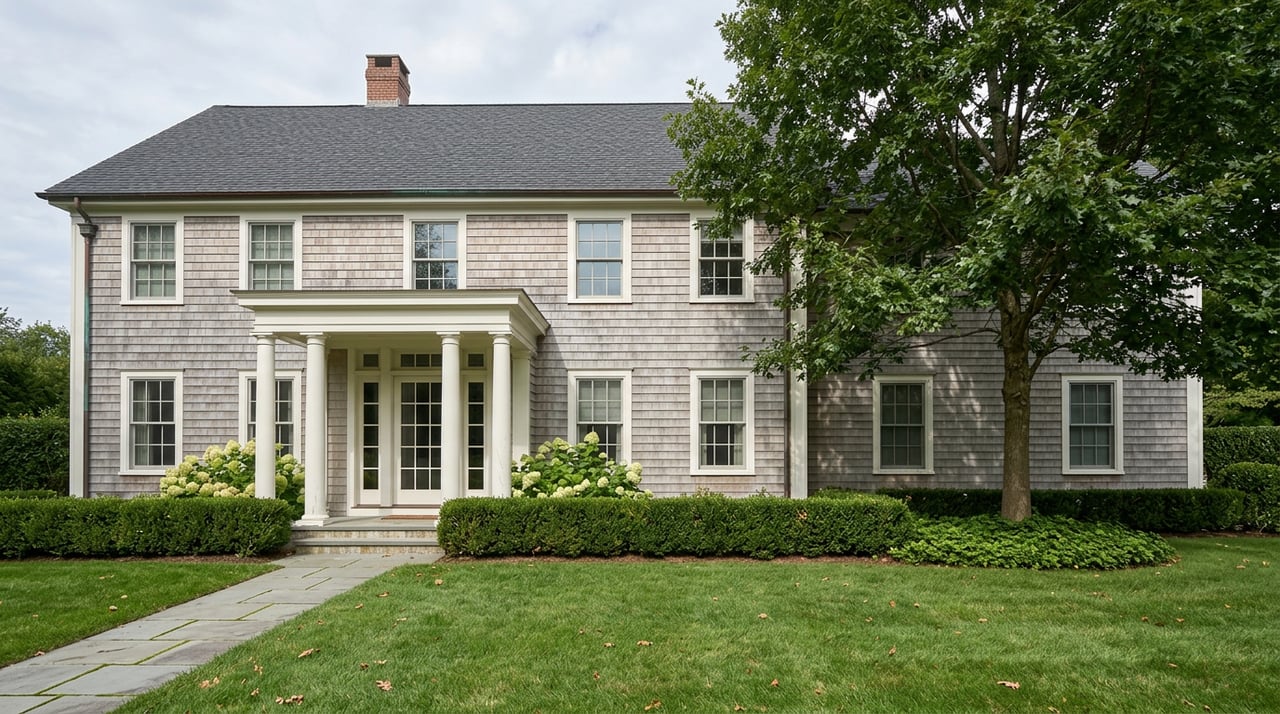
Chestnut Hill and its Fisher Hill neighbor were built for a different unit of measurement than the rest of Brookline. Fisher Hill was laid out by Frederick Law Olmsted as a garden suburb for Boston's wealthy merchant class, and the housing stock still reflects that intent. You will not find triple-deckers on these streets. You will find Queen Anne, Shingle, and Colonial Revival manor homes on lots that run a quarter acre to a full acre or more, some of them protected by the Fisher Hill Historic District. A handful of the grandest estates, including the Longyear at Fisher Hill, have been converted into gated condominium buildings that still trade on the scale of the original mansion rather than a subdivided footprint.
A listing that came to market that same window makes the arithmetic concrete: 540 Chestnut Hill Avenue was asking $4,250,000 for 6,419 square feet across five bedrooms and five bathrooms, four fireplaces, and stone terraces on a lot near the Reservoir. Run the math on the ask alone and that home priced out around $662 per square foot, well under Chestnut Hill's already-below-average benchmark, because the sheer volume of finished space diluted the per-foot cost even at a multi-million-dollar price.
That is the mechanism. Chestnut Hill's total price is enormous because the homes are enormous. The land and the square footage are the product. Per unit of space, that product costs less than the compact stock a mile and a half away.
What a Coolidge Corner dollar buys
Coolidge Corner is selling something else entirely: proximity. The neighborhood's commercial core along Harvard and Beacon Streets sits at the Green Line C stop, and its condo stock skews toward pre-war brick apartment buildings converted into two-bedroom units that function as the neighborhood's sweet spot for both resale and rental demand. A separate analysis of Coolidge Corner condo sales found the median unit measuring 1,152 square feet in a 2025 sample, growing to 1,395.5 square feet in the 2026 sample, while price per square foot barely moved, holding near $850 across both years. Buyers in 2026 purchased somewhat larger units, but they paid essentially the same rate for every additional foot, because the rate itself is set by walkability and transit access, not by size.
That is why Coolidge Corner's per-foot price outruns Chestnut Hill's even though its total transaction prices run a third of Chestnut Hill's median. You are not paying for more house. You are paying for less distance to the train, the theater, and the shops.
Why the more expensive address is the better deal by the foot
Every real estate market prices scarcity, and Brookline is pricing two different kinds of scarce good in these two places. In Chestnut Hill, the scarce good is intact, large-lot land close to a major city, protected in part by historic district rules that limit teardown-and-rebuild density. In Coolidge Corner, the scarce good is a walkable, transit-adjacent lifestyle packed into a compact footprint where there is no more land to add. Land is expensive everywhere in Brookline. What varies is how much of that expense gets divided across how many square feet, and that division is what price per square foot actually measures.
A buyer chasing the lowest total price will gravitate to Coolidge Corner. A buyer chasing the lowest cost per square foot of finished space, the metric that matters more for anyone weighing renovation costs, resale comparables, or long-term value per dollar invested, will find that math favors Chestnut Hill, even though the entry price is far higher.
The wildcard sitting on Route 9
Anyone comparing these two areas for the next five years should also know that Chestnut Hill's commercial edge is about to change shape. On May 28, 2026, Brookline's Town Meeting voted 217 to 20 to approve zoning for a major mixed-use redevelopment along Route 9, covering roughly 27.8 acres over six blocks between Hammond Street and Hammond Pond Parkway. The project, led by developer City Realty at the former office park at 1280-1330 Boylston Street, calls for three buildings reaching 14, 12, and 7 stories, combining a 200-room hotel, 266 apartments and condos, medical office space, and ground-floor retail. Town officials estimate it will bring in $4 to $6 million a year in new commercial tax revenue, a meaningful figure for a town that also passed a $23 million property tax override this year.
Coverage through the summer indicated the project was moving from zoning approval into design review, with permitting and construction expected to stretch across several years before anything opens. Neighbors near the site have been vocal about the height. As one nearby resident put it during the community review process, "it's not because we can't see the birds" that twelve or fourteen stories felt wrong for the corridor. The concern was never really about sightlines. It was about whether a stretch of Route 9 that has looked the same for decades is about to feel like a different kind of place.
For a buyer choosing between Chestnut Hill and Coolidge Corner, that matters less as a reason to avoid the area and more as a reason to time expectations correctly. Properties within a half mile of the overlay district may see construction noise and traffic disruption for the next few years, with the payoff being new retail, dining, and hotel amenities arriving on Chestnut Hill's own doorstep once the project is built out. It is the kind of change that reshapes a neighborhood's per-square-foot math over time, not overnight.
What this means if you are the one comparing
If your priority is square footage, land, and a historic pedigree that holds its value, Chestnut Hill and Fisher Hill will cost more to get in the door and less per foot once you are inside it. If your priority is walking to the train, the theater, and the shops without a car, Coolidge Corner will ask a premium for every foot of that convenience, even in a modest two-bedroom. Neither number is the whole story on its own. The median price tells you what a typical transaction costs. The price per square foot tells you what you are actually paying for. Reading only one of them is how a buyer ends up surprised at the closing table, or worse, overpaying for space they never needed because they compared the wrong figure.
Frequently asked questions
Does a higher price per square foot always mean a worse deal? Not necessarily. It means you are paying a premium for something other than raw space, usually location, transit access, or finish quality. Whether that premium is worth it depends on how much you value what it buys.
Will the Route 9 redevelopment raise or lower nearby home values? It is too early to say with certainty. Construction-phase disruption tends to create short-term hesitation among buyers, while the finished project's added tax base, retail, and hotel amenities are the kind of investment that has historically supported values in comparable corridors once built out.
Is the Chestnut Hill referenced here the same as Chestnut Hill, Newton? This comparison covers the Brookline side of Chestnut Hill, which shares its name and its Route 9 corridor with adjacent sections in Newton and Boston but sits under separate zoning, tax rates, and Town Meeting governance.
If you are trying to figure out which side of this trade makes sense for your budget and your priorities, that is exactly the kind of conversation worth having before you start touring. The Robin Allen Group works both sides of this comparison every month and can walk you through what a specific address, lot, and price actually buys before you make an offer. Request a private consultation to start that conversation.